Computational Science
What?
Computational science seeks to gain an understanding of science through the use of mathematical models on computers.

Essentially, we take a real-world problem from biology, physics, geology, medicine, engineering, or any other scientific field, and model it with one or more mathematical equations.
A “virtual simulation” of the problem we are studying may then be carried out by “solving” the equation(s) with a computational tool:
- Software applications: StarLogo, Stella, Excel, Matlab, Mathematica, etc.
- Programming languages: Fortran, C, C++, Java, etc.
We then observe, identify, and describe the behavior of our simulation – i.e. we conduct scientific research using a virtual model instead of a real-world (physical) model.
Clearly, computational Science is a multidisciplinary activity. It brings together people from a variety of fields. TEAMWORK IS NECESSARY FOR SUCCESS!!
Questions you might discuss with the students – pushing ‘teamwork’ aspect:
· What is the ‘area of science’ for your project?
· Of the three areas shown above, who is an expert in “Computers”, “Science”, and/or “Mathematics”
· Which area do you think is the easiest/hardest?
· Where will you go for help?
· What other skills do you think will be necessary? (e.g. writing, research)
Inform students that some projects will not necessarily fit into this mold! AiS Challenge staff assisting with the ‘Abstract Review’ class will determine whether or not their project is acceptable.
Why?
Physical experimentation may be too large, too expensive, too dangerous, and/or too time consuming.
Examples:
- Boeing 777 – First jetliner to be digitally designed and "pre-assembled" on a computer.
- Eliminated need for costly/time consuming full-scale development.
- http://www.boeing.com/commercial/777family/compute/index.html
- Nuclear Weapons – National Laboratories “virtually” test nuclear weapons.
- Physical testing is dangerous, expensive, controversial, etc.
- “Legally” cannot test – Comprehensive Nuclear Test-Ban Treaty
Point out to students that Computational Science complements, but does not replace, theory and experimentation in scientific research!
e.g. theoretical ideas and previous experimentation may lead to mathematical equations which allow you to create a new “virtual airplane”. However, you would still build and test a physical prototype before going into full-scale production to verify that it really works!
With Computational Science we are often able to make an educated guess as to what may happen in the future!
More Examples: earthquake prediction, forest fire behavior, population modeling (e.g. bark beetles vs. trees), weather forecasting, asteroid impact on Earth, traffic flow
Questions you might discuss with the students:
· Why are some of these examples best studied in a “virtual” world?
· Are some examples impossible to study in the real world?
· How would you verify the results of these examples? i.e. how would you determine whether or not your virtual simulation really represents what would happen in the real world?
With Computational Science, we are also easily able to perform “what if” experiments! e.g. what if we use titanium instead of aluminum for the frame of our airplane? What if the asteroid impacts New Mexico instead of the Pacific Ocean? We simply modify our equations/computational tool and re-run the simulation!
How?
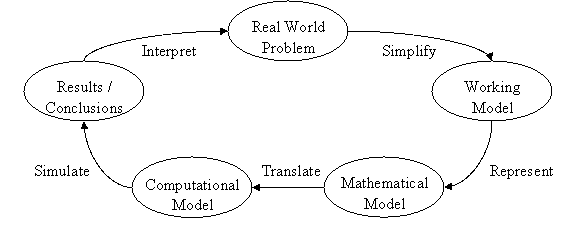
Bark Beetle (BB)! Question the students and see how they think the Bark Beetle problem can be investigated using each of these steps. They will actually do this in a later class.
- Identify your Real World Problem
- Perform background research. Focus on a “workable” problem.
- BB: tree health/moisture/density/type, beetle lifespan/birth rate/travel rate, wind, temperature, etc. (see if students can identify these and others)
- Simplify problem into a Working Model
- Identify and select factors that describe the most important aspects of the Real World Problem; determine those factors which can be neglected.
- BB: e.g. disregard wind, temperature, tree type, etc. (see which factors the students consider to be important/irrelevant)
- Represent problem using a Mathematical Model
- Express the Working Model in mathematical terms; write down mathematical equations whose solution describes the Working Model.
- In general, the success of a mathematical model depends on how easy it is to use and how accurately it predicts future behavior
- BB: students will see this in a later class
- Translate equations into a Computational Model
- Change Mathematical Model into a form suitable for computational solution.
- Computational models include software such as StarLogo, Stella, Excel, Matlab, or Mathematica, or languages such as Fortran, C, C++, or Java.
- BB: students will see this in a later class – Java or StarLogo
- Results/Conclusions
- Run “Computational Model” to obtain Results; draw Conclusions.
- Graphs, charts, and other visualization tools are useful in summarizing results and drawing conclusions.
- Verify your results! Compare to similar problems with known results, etc.
- BB: students will see this in a later class
- Maybe draw a graph here that shows what results could possibly look like. i.e. an x-y plot of beetles/trees vs. time.
- Interpret conclusions and compare with Real World Problem behavior.
· If results do not “agree” with physical reality or experimental data, reexamine the Working Model and repeat modeling steps.
· Often, the modeling process proceeds through several iterations until model is “acceptable”.
Where?
The “mode” machine offers sophisticated computing power and resources. Modern PCs, however, are powerful enough to handle most AiS Challenge projects.
Students may edit, compile, and execute computer programs written in Fortran, C, C++, Java, and other languages on Mode.
Software applications, as well as some programming languages, are best used on their own PCs. e.g. Java (if using graphical components), Excel, StarLogo
Ask the students what “supercomputing” is. Then, point out the following:
- The Adventures in Supercomputing Challenge is a computational science program.
- Supercomputing (i.e. using a supercomputer) is often necessary when conducting computational science.
- The definition of a supercomputer changes constantly since computers/computing techniques are continually getting better and faster. An example from today includes parallel/distributed computing.
Accounts on a “real” supercomputer may be granted to those teams who demonstrate the need for substantial amounts of computing power.
When?
Work on your project as soon, and as often, as possible. The 2004 deadline is April 7th.