|
|
|
|
The integrated defense system of Boeing Ion Propulsion Center is now part of Boeing’s newest part of the Boeing Satellite Development Center. Boeing has created the world’s first commercial satellite to carry a brand new propulsion system that is ten times more efficient than the systems currently in use. The XIPS (pronounced “zips”), xenon ion propulsion system, is the combined power of four decades of research about ion propulsion as an alternative to chemical propulsion. The efficiency of crafts, such as Boeing 601 HP, or high power, and Boeing 702 satellite models, is increased efficiency allows the reduction in propellant mass of up to 90% for a satellite designed for 12 to 15 years of work. This allows of less in cost for launch, increase in satellite lifetime, and increased payload.
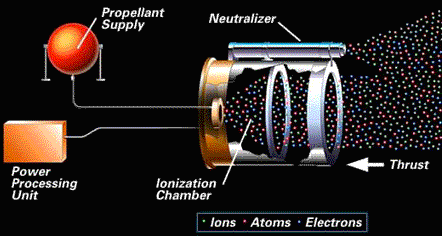
“Thrust is created by accelerating the positive ions through a series of gridded electrodes at one end of the thrust chamber. The electrodes, known as an ion extraction assembly, create more than 3,000 tiny beams of thrust. The beams are prevented from being electrically attracted back to the thruster by an external electron-emitting device called a neutralizer. Ions ejected by the Hughes-designed XIPS travel in an invisible stream at a speed of 30 kilometers per second (62,900 miles per hour), nearly 10 times that of its chemical counterpart. And, because ion thrusters operate at lower force levels, attitude disturbances during thruster operation are reduced, further simplifying the station keeping task (http://www.boeing.com/defense-space/space/bss/factsheets/xips/xips.html)”
|
|
Questions/Concerns Contact the
Webmaster Home | Compare | Photos | Final Report |